A content strategist at a B2B software company recently described her week to a colleague: Monday spent chasing campaign performance data across four different platforms, Wednesday rewriting copy that a junior team member had drafted three times, Friday in a meeting debating whether last month’s email open rate was actually meaningful. At no point in that week did she feel like she was doing strategy. She felt like she was managing noise.
This is the quiet frustration sitting beneath the surface of almost every marketing team right now. And it is exactly the kind of friction that AI is beginning to dissolve. Not by replacing the strategist, but by clearing away the clutter that was stopping her from doing the actual job.
The conversation around AI and marketing has spent too long in two unproductive extremes. On one side, the panic: robots are coming for your job. On the other, the dismissal: it is just a fancy autocomplete tool. Neither view is useful, and neither reflects what is actually happening inside organisations that are using these tools effectively. What is happening is more interesting, and more demanding, than either camp acknowledges.
What AI Is Actually Doing Well in Marketing Right Now
The honest starting point is capability. AI is not uniformly good at everything marketing requires. It is, however, genuinely excellent at a specific set of tasks that have historically consumed a disproportionate amount of marketing time.
Data synthesis is one. Tools like Google’s Performance Max campaigns use machine learning to analyse audience signals across Search, YouTube, Gmail and Display simultaneously, making bid and placement decisions faster and at a scale that no human team could manage manually. The output is not perfect, but the efficiency gain is real.
Content generation is another. Brands like Coca-Cola and JPMorgan Chase have piloted AI tools to assist with copy creation, and both have reported that the value is not in replacing writers but in accelerating the iteration process. You go from one draft to five variations in the time it used to take to produce one. The strategist then selects and refines. That shift, from production to curation, changes what the job actually requires.
Personalisation at scale is perhaps where the impact is most visible. Amazon’s recommendation engine, which drives a significant share of its revenue, is one of the most cited examples in marketing for good reason. It does not guess what customers might want. It learns from behavioural data in ways that no human analyst could replicate across hundreds of millions of users. Smaller companies are now accessing similar logic through tools like Klaviyo, Dynamic Yield, and HubSpot’s AI features.
The common thread in all of these examples is that AI handles the mechanical and the repetitive. The human still owns the judgment.
Where Human Judgment Remains Non-Negotiable
This is the part that rarely gets explained clearly enough.
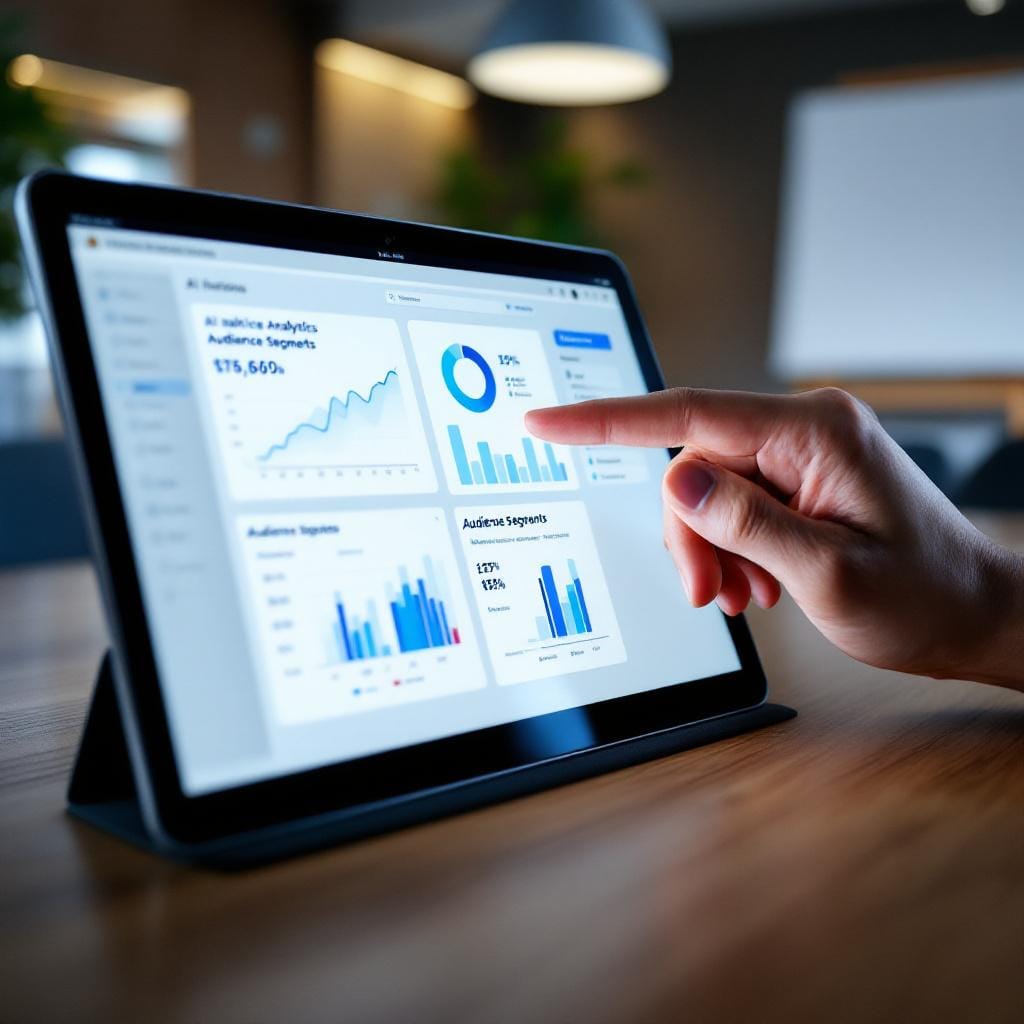
AI decision making in marketing is not about handing decisions to a machine. It is about using machine-generated insight to inform decisions that humans then make. The distinction matters enormously, and teams that blur it tend to get into trouble.
Consider brand voice. An AI tool can analyse your previous copy and generate new content that sounds consistent with your tone. But it cannot understand why a particular campaign landed well with your audience in a specific cultural moment. It cannot tell you whether a message feels tone-deaf given what is happening in the news cycle, or whether a creative direction aligns with a repositioning your brand is quietly working through. That contextual awareness is human territory.
The same applies to campaign strategy. AI can tell you which segments responded well to which message last quarter. It cannot tell you whether you should be targeting those segments at all given your five-year brand goals, your margin situation, or a competitor shift your leadership team is watching. Strategy requires synthesis across information that does not live in any dataset.
There is also the question of ethics and judgment. When Spotify uses listening behaviour to serve personalised messaging, the technology works. But human marketers still decide where the line sits between personalisation that feels useful and personalisation that feels invasive. That is a judgment call rooted in values, not data.
The New Shape of a Marketing Role
What is emerging in teams that are genuinely adapting is a different kind of workday. Routine tasks compress. The time recovered flows into higher-order work.
A social media manager who previously spent three hours scheduling posts, captioning images, and pulling engagement reports now does that in forty minutes. The question is: what happens to the other two hours and twenty minutes? In teams that are growing, those hours go into audience research, community building, creative experimentation. In teams that are struggling to adapt, those hours get absorbed by other low-value tasks, or the efficiency gain simply disappears into slack.
This is a critical pattern that gets missed in broad conversations about AI and employment. The technology creates capacity. Capacity is only valuable if it gets redirected intentionally. That is a management and culture problem as much as a technology problem.
The marketers who will matter most over the next five years are not the ones who know the most tools. They are the ones who know how to ask better questions of the data those tools produce.
The emerging skill set looks something like this:
- The ability to brief AI tools effectively, which requires clarity of thought about what outcome you actually want
- The ability to evaluate AI-generated content, data, or recommendations critically rather than accepting outputs at face value
- Stronger strategic communication skills, because the mechanical justification for decisions is increasingly automated, and humans must supply the reasoning that machines cannot
- Cross-functional fluency, since AI outputs often sit at the intersection of marketing, product, and data teams
What Most Companies Get Wrong During the Transition
The most common mistake is treating AI adoption as a tools rollout. A platform gets licensed, a training session gets scheduled, and the expectation is that productivity improves. It rarely works that way.
The deeper issue is that AI does not improve broken workflows. It accelerates them. If your team does not have a clear process for turning data into decisions, adding an AI analytics layer will not fix that. It will generate more data faster, and the confusion will compound.
A second mistake is over-relying on AI for creative work without maintaining genuine creative standards. When content mills and low-quality brands flood channels with AI-generated copy, audiences develop a sensitivity to it. The brands that hold attention are the ones using AI to enhance creative quality, not replace the standard that humans set.
The third mistake is the most strategic: underestimating how much AI decision making in marketing requires human interpretation to be useful. A tool might surface a strong insight about audience behaviour. But if the marketing team lacks the business context or analytical confidence to act on that insight, the value disappears. Capability without judgment is just data.
What This Means for Your Career
If you are reading this as someone feeling the pressure to adapt, the reassurance worth holding onto is this: the demand for skilled marketers is not declining. It is shifting. The skills that were most valued in the previous decade, volume production, manual reporting, templated execution, are becoming less scarce. The skills becoming more valuable are strategic thinking, creative direction, audience empathy, and the ability to operate with confidence at the intersection of data and judgment.
That shift does not require you to become a data scientist. It requires you to become a more deliberate professional. Someone who asks sharper questions, tests ideas more systematically, and can explain the reasoning behind a recommendation in a room where others are deferring to numbers.
Organisations are finding that the marketers who adapt fastest are not always the youngest or the most technically inclined. They are the ones with genuine curiosity and the willingness to think out loud about what a tool is actually telling them.
A Practical Starting Point
If you are trying to find a productive entry point without getting lost in tool overload, start with one area of your current work that is genuinely time-consuming and low on strategic value. Map what that process looks like today. Then explore whether an AI tool can handle any part of that process well enough to free your time.
Do not start with the most complex campaign element. Start with the task that drains you most. Build familiarity. Develop your own sense of where the tool is reliable and where it needs close oversight. That practical experience, earned through doing rather than watching demos, is what builds genuine confidence.
The goal is not to become an expert in AI. The goal is to become a better marketer with sharper tools at your disposal.
If you want to explore this in a structured, practical format with real workflows and live guidance, the Harnessing AI for Marketing Innovation workshop is designed exactly for this kind of professional development. It focuses on real application rather than theory, and it is built for marketers, not engineers.
The job is changing. That is not a threat. It is the most significant professional development opportunity this generation of marketers has had.
—