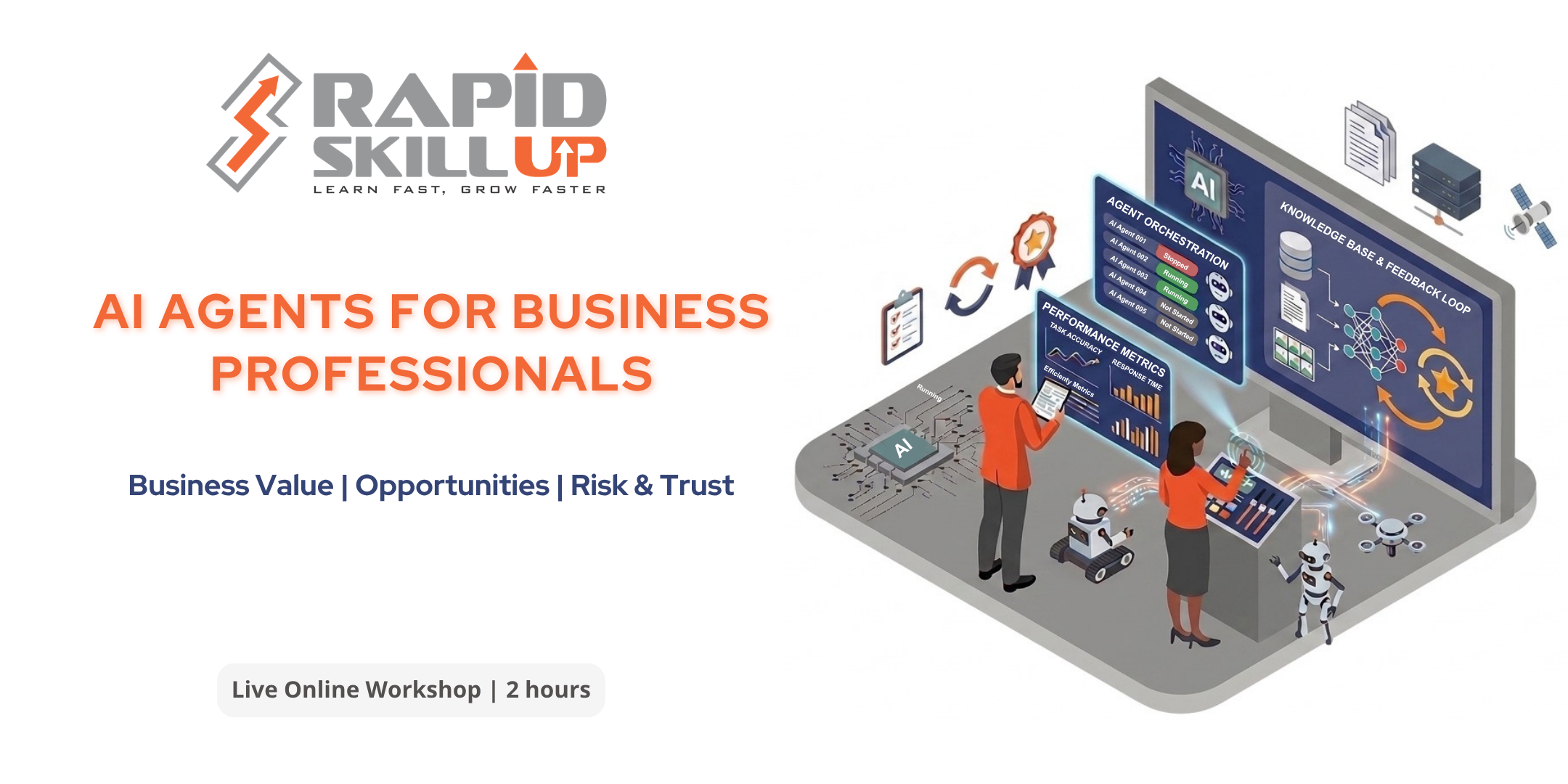
A customer service manager at a mid-sized insurance company recently discovered that a piece of software had been quietly handling policy renewals for three weeks. Not flagging them for review. Not drafting suggestions for a human to check. Actually completing them, updating records, and sending confirmation emails, start to finish. Nobody had announced this as a major rollout. It had been switched on as a pilot, worked well enough, and simply kept running. The manager found out when a colleague mentioned it in passing.
This is roughly where things stand right now. AI agents for business are no longer a research topic or a future capability sitting on some vendor’s roadmap. They are already embedded in customer service queues, finance departments, recruitment pipelines, and supply chain systems at companies most of us interact with regularly. And a large number of professionals, even senior ones, have not caught up to what that actually means for their day-to-day work.
What an AI agent actually is, without the jargon
Most people have used a chatbot or an AI writing tool at this point. Those tools respond when you ask them something. You type a question, you get an answer, the interaction ends there. An AI agent works differently. It is given a goal, and it takes a sequence of actions on its own to achieve that goal, checking its progress, adjusting its approach, and often completing multi-step tasks without a human clicking “next” at every stage.
Think of the difference between a calculator and an assistant. A calculator waits for input and gives you output. An assistant, if you tell them “sort out the vendor invoices that came in this week,” will open the emails, check the amounts against purchase orders, flag discrepancies, and put together a summary for you, all without you specifying every single step.
That is what companies are now deploying. Salesforce has built agent-based tools into its customer service platform that can resolve support tickets independently. Klarna has publicly stated that its AI assistant handles a workload equivalent to hundreds of full-time customer service agents. Amazon uses automated agents deep inside its logistics and inventory systems to make real-time decisions about stock movement without waiting for a person to approve each one. These are not experimental side projects. They are core operational infrastructure.
Why this is different from the AI most people have already accepted
Plenty of professionals feel reasonably comfortable with generative AI tools by now. They use them to draft emails, summarize documents, or brainstorm ideas. That comfort has created a false sense of readiness. Using ChatGPT to write a report is a fundamentally different skill from overseeing a system that independently manages a workflow involving real money, real customers, or real compliance risk.
Here is the practical distinction that gets missed constantly: generative AI produces content, and a human decides what to do with it. AI agents take actions, and a human’s role shifts to designing the guardrails and reviewing the outcomes after the fact. That is a much bigger leap in responsibility than most job descriptions currently account for.
A 2024 McKinsey survey on AI adoption found that while a large majority of organizations report using generative AI in at least one business function, a much smaller percentage feel they have the governance structures in place to manage more autonomous AI systems responsibly. That gap between adoption and readiness is exactly where the risk sits.
Where AI agents are already doing real work
It helps to look at specific functions rather than abstract descriptions, because the applications are genuinely varied.
- Customer service: Airlines and telecom companies use agentic systems to handle rebooking, refunds, and account changes end to end, escalating to a human only when a case falls outside defined parameters.
- Recruitment: HR platforms use agents to screen applications, schedule interviews, and send personalized follow-ups, reducing the administrative load on recruiters while still leaving final hiring decisions to people.
- Finance and procurement: Agents reconcile invoices, flag anomalies in spending patterns, and route approvals automatically, work that used to consume hours of junior staff time every week.
- Marketing operations: Agents manage ad bidding, adjust campaign budgets in response to performance data, and generate reporting dashboards without a marketer manually pulling numbers each morning.
- Supply chain management: Retailers use agents to predict demand shifts and automatically adjust orders with suppliers, a task that previously required constant manual monitoring.
The common thread across all of these is that the AI agent is not replacing judgment entirely. It is replacing the repetitive, rules-based portion of a job that previously consumed disproportionate time, while leaving exceptions and edge cases for a human to resolve.
What professionals consistently get wrong about this shift
The most common misunderstanding is thinking of AI agents as a slightly smarter chatbot. That framing leads people to underestimate both the opportunity and the risk. An agent that can independently process refunds or adjust supplier orders is making decisions with real consequences, and treating it like a glorified FAQ tool means nobody is asking the right questions about oversight.
The second mistake is assuming this only affects technical teams. It doesn’t. A marketing manager whose campaign budget gets adjusted overnight by an agent needs to understand why that decision was made and whether it aligns with strategy. An HR lead using an agent to screen candidates needs to understand what criteria the system is actually weighting, because getting this wrong can create legal exposure around bias, as several companies have already discovered the hard way through discrimination complaints tied to automated hiring tools.
The third mistake is expecting this to be a smooth, gradual rollout that happens on a predictable timeline. In practice, adoption tends to happen unevenly. One department moves fast because a vendor offered a compelling pilot, while another department has no plan at all. This unevenness is often more disruptive than a company-wide rollout would be, because it creates inconsistent expectations across teams and unclear accountability when something goes wrong.
The businesses that adapt well are not the ones with the most advanced technology. They are the ones whose people understand what the technology is actually doing.
The oversight question nobody wants to answer honestly
Every serious conversation about AI agents eventually runs into the same uncomfortable question: what happens when the agent makes a mistake, and who is responsible for catching it?
This is not hypothetical. In 2023, a Canadian tribunal ruled against Air Canada after its customer service chatbot gave a passenger inaccurate information about a bereavement fare, and the airline was held responsible for the AI’s error rather than being able to disclaim it. The case involved a simpler chatbot rather than a fully autonomous agent, but the underlying lesson applies with even more force to agentic systems: the company remains accountable for what its AI does, regardless of how independently that AI operated.
This is why the skill that matters most right now is not learning to build these systems. It’s learning to supervise them. That means understanding what data an agent is working from, what boundaries it operates within, how errors surface, and what the escalation path looks like when something falls outside normal parameters. Professionals who can do this well become significantly more valuable, not because they can code, but because they can be trusted to manage a system that acts without constant human input.
Practical steps for professionals who feel behind
If this all sounds overwhelming, that reaction is common and reasonable. The good news is that catching up does not require a technical background. It requires a shift in how you think about your own role.
Start by identifying where in your current job an AI agent is already active or likely to be introduced soon. If you work in customer-facing operations, finance, HR, or marketing, there is a strong chance something is already running, even if nobody has explained it clearly to you. Ask directly. Most vendors and IT teams can tell you exactly what an agent is doing if you ask specific questions rather than general ones.
Next, get comfortable with the language of oversight rather than the language of automation. Instead of asking “can AI do this task,” ask “what happens when this AI gets it wrong, and how would I know?” That single question reframes how you evaluate every tool your organization adopts.
Finally, resist the pressure to either fully embrace or fully dismiss this shift. Both extremes lead to poor decisions. Blind enthusiasm leads to deploying agents without proper checks, which is how companies end up with the kind of public missteps Air Canada experienced. Blind skepticism leads to falling behind competitors who are quietly becoming faster and cheaper to operate.
What this means for the next two to three years
Analysts including those at Gartner have projected that a significant share of everyday business decisions currently made by humans will shift toward AI-driven or AI-assisted processes over the next few years. Whether the exact figures hold up, the direction is clear and already visible in the examples above. This is not a distant forecast. It is a description of what is already underway inside companies like Salesforce, Klarna, and Amazon, and it is spreading into mid-sized organizations far faster than most leadership teams have communicated internally.
The professionals who will do well in this environment are not necessarily the most technical people in the room. They are the ones who understand what these systems are doing well enough to ask good questions, spot problems early, and explain decisions to customers, regulators, or colleagues when something needs a human explanation. That is a skill set built through exposure and practice, not through formal computer science training.
Feeling behind right now does not mean you are behind in any permanent sense. It means the learning curve has arrived at the same time for almost everyone, including people who have spent decades in leadership roles. The professionals who take that seriously over the coming year will find themselves in a genuinely different competitive position than those who wait for someone else to explain it to them.
If you want a structured, practical way into this, our live workshop on AI Agents for Business Professionals walks through real workflows, real oversight questions, and real examples from companies already doing this well, without assuming any technical background walking in.