What if the biggest threat to your career isn’t AI replacing you, but someone who knows how to use AI replacing you? Not a developer. Not a data scientist. Just a professional in your field who learned one skill you haven’t picked up yet.
That skill is knowing how to work with AI agents. And right now, most professionals either haven’t heard of them, or have heard just enough to feel confused and move on. That’s a mistake worth addressing before the gap gets wider.
What AI Agents Actually Are (Without the Technical Noise)
Most people have tried a chatbot at some point. You type a question, it gives you an answer. Useful, but limited. AI agents are different. They don’t just respond to questions. They take actions, make decisions across multiple steps, and complete tasks with far less hand-holding.
Think about how Amazon’s fulfilment operation works. Automated systems monitor inventory levels, predict demand, adjust pricing, and flag supplier issues without a human reviewing each decision. That same logic is now being embedded into tools that ordinary business professionals can access and direct.
An AI agent might monitor a competitor’s pricing and send you a weekly summary. It might screen inbound job applications, schedule interviews, and draft follow-up emails. It might pull data from three platforms, generate a report, and flag the two numbers your manager actually needs to act on. The common thread is that these aren’t one-prompt tasks. They’re workflows, and they run with minimal input once set up.
The professionals who understand how to design, direct, and oversee these workflows will have a compounding advantage over those who are still doing every step manually.
Why This Skill Is Being Overlooked

There’s a pattern in how new technology gets adopted in the workplace. First, IT teams and early adopters explore it. Then organisations run pilots. Then leadership starts asking why more people aren’t using it. That third stage is where a lot of companies are right now with AI agents, which means the window to get ahead is still open, but it won’t stay open for long.
Part of the reason this skill gets ignored is that the word “agent” sounds technical. People assume they need to understand code, or at least something close to it. They don’t. The practical skill here isn’t programming. It’s knowing how to think in workflows. What steps does this task actually involve? Where does human judgement matter? Where can a system handle the routine parts without risk?
This is a thinking skill, not a technical one. And it sits squarely in the zone that business professionals already occupy.
The other reason it gets overlooked is that most AI training focuses on tools, not systems. Learning how to use a specific tool is fine, but it makes you dependent on that tool. Learning how AI agents work as a category teaches you something more portable, and more durable.
What This Looks Like Across Different Roles
It’s tempting to think of AI agents as something relevant only in tech companies or large enterprises. The reality is different.
In marketing, agencies are already using AI agents to monitor campaign performance across channels, flag underperforming ads, and generate draft creative briefs based on what’s working. A marketing manager who knows how to set up and oversee these workflows can do the strategic thinking their role demands, instead of spending half the week in spreadsheets.
In HR, organisations are using agent-based systems to handle the early stages of recruitment, manage onboarding communications, and track employee engagement signals over time. HR professionals who understand how to configure these systems and where human review is non-negotiable are more valuable than those who either resist the tools or adopt them without critical oversight.
In finance and operations, AI agents are being used to monitor contract renewal dates, reconcile transaction data, and surface anomalies before they become problems. Goldman Sachs and JP Morgan have both invested heavily in agent-based automation across their operational layers. The professionals managing those systems aren’t coders. They’re people who understand the business process deeply enough to know what should and shouldn’t be automated.
The Mistake Most Professionals Make When They Start
When professionals do start exploring AI agents, there’s a common mistake worth naming. They try to automate everything at once, or they automate the wrong things first.
Automation works best on tasks that are:
- Repetitive with a clear structure
- Low-risk if occasionally wrong
- Time-consuming relative to the value of a human making each decision
It works poorly on tasks that require nuanced judgement, relationship sensitivity, or where a mistake has real consequences. A recruitment agent that screens CVs based on flawed criteria doesn’t save time. It introduces bias at scale.
The professionals who get this right start small. They identify one workflow that genuinely costs them time, map it out step by step, and then explore where an agent can take over the routine parts. They stay in the loop on the outputs. They build trust in the system gradually.
That approach sounds obvious, but it requires understanding both the business context and the tool’s limitations. That combination is rarer than it should be.
The Two-Year Window
There’s a reason the timeline matters. Research from McKinsey and the World Economic Forum consistently points to the next two to three years as the period when AI-driven workflow automation moves from early adoption to mainstream expectation. Companies that have already built internal capability will move faster. Professionals who already understand how to work with these systems will be the ones directing the next round of change, not responding to it.
The gap between professionals who understand AI agents and those who don’t will not stay narrow.
This isn’t about becoming an AI expert. It’s about becoming someone who can participate in decisions about how AI gets used in your organisation, rather than having those decisions made around you.
Where to Start
If you’re not sure where to begin, start with observation rather than action. Look at your week and identify the tasks that feel routine but eat time. Consider which of those tasks follow a predictable pattern. Those are the candidates worth exploring.
From there, the practical step is learning enough about how AI agents work to have an informed conversation, ask the right questions, and evaluate what tools or systems make sense for your context. You don’t need to build anything. You need to understand enough to lead.
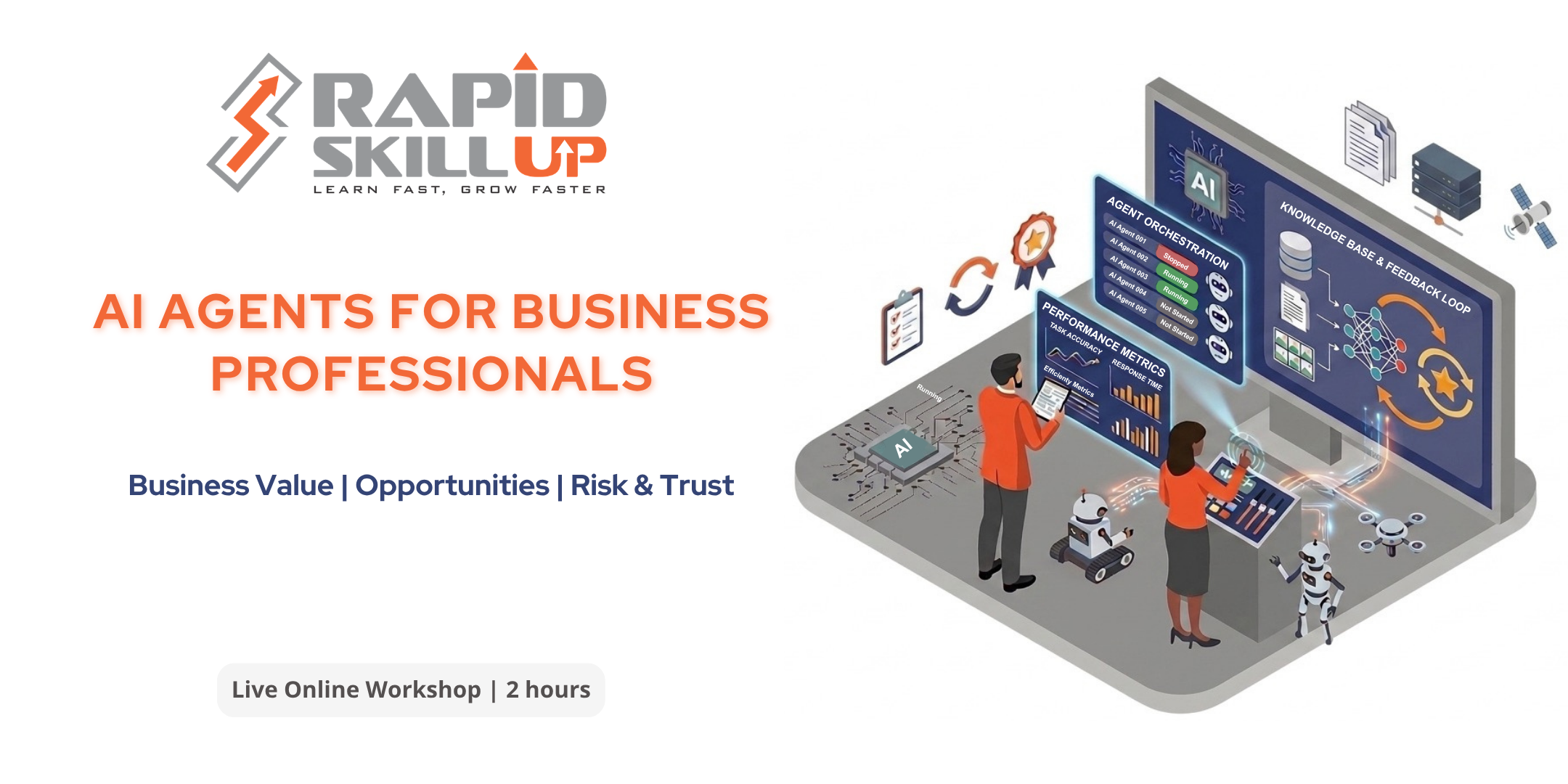
If you want to explore this in a practical, guided format, the AI Agents for Business Professionals workshop at RSU covers real-world examples and workflows designed specifically for professionals who want to get up to speed without wading through technical complexity. It’s built for exactly the kind of person reading this.
The professionals who will look back on this period as a career advantage are the ones who started learning before it became urgent. That moment is now.