
If you work in marketing, AI can feel like one more thing to learn in an already crowded job. There is a lot of noise around it. Big promises. Bigger jargon. But most marketers do not need to build models, write code, or understand the machinery under the hood. They need useful ways to save time, sharpen ideas, and run better campaigns.
That is where AI becomes interesting. Not as a replacement for judgment, taste, or strategy, but as a practical assistant. It can help you move faster on the repetitive parts of campaign work, surface patterns you might miss, and create more room for the work that still depends on human instinct.
If you have been wondering how to use AI in marketing campaigns without becoming “technical,” the good news is simple: start small, use it where friction already exists, and keep a human hand on the wheel.
Start with audience research
Most campaigns struggle before they begin. The targeting is too broad, the message too generic, or the assumptions too old. AI can help you organize messy audience input and turn it into a clearer picture of who you are trying to reach.
You can use AI to:
- Summarize survey responses
- Group customer reviews by recurring pain points
- Pull out common objections from sales call notes
- Draft rough audience personas from existing data
For example, imagine a training company collecting feedback from webinar attendees. Instead of reading 300 responses one by one, a marketer can ask AI to identify common themes: lack of time, unclear career paths, fear of falling behind. That gives shape to a campaign message very quickly.
The value is not that AI “knows” your audience. It does not. The value is that it helps you see patterns faster so you can ask better questions.
Use it to generate message variations
Writing campaign copy can be surprisingly draining, especially when you need ten versions of the same idea for email, social, ads, and landing pages. AI is useful here, not because it writes perfect copy, but because it gives you starting points.
You might ask it to create:
- Three headline options for a LinkedIn ad
- Five email subject lines for a product launch
- A shorter version of a landing page paragraph
- Different tones for the same message, such as direct, warm, or urgent
A non-technical marketer at a small business might upload a basic campaign brief and ask for copy versions aimed at first-time buyers versus returning customers. That does not replace editing. But it can cut the blank-page phase in half.
AI is often most valuable at the beginning of the work, when speed matters and perfection does not.
The key is to guide it well. Give context. Include the audience, the offer, the desired tone, and the action you want readers to take. Better input usually leads to better output.
Personalize content without overcomplicating it
Personalization used to sound expensive and difficult. AI makes it more accessible, especially for teams without large budgets or technical support. You do not need a sophisticated system to begin. Even simple audience segments can go a long way.
AI can help tailor:
- Email introductions by industry or role
- Product recommendations by past behavior
- Ad copy by customer segment
- Follow-up messages based on engagement level
Say you are promoting an online workshop. Instead of sending one generic email to everyone, you can create separate versions for managers, freelancers, and early-career professionals. AI can help rewrite the same core message for each group while preserving consistency.
This matters because people are quick to ignore marketing that feels broad and indifferent. They respond better when the language reflects their situation. AI can help make that adjustment easier, especially when your team is small.
Turn one piece of content into a full campaign
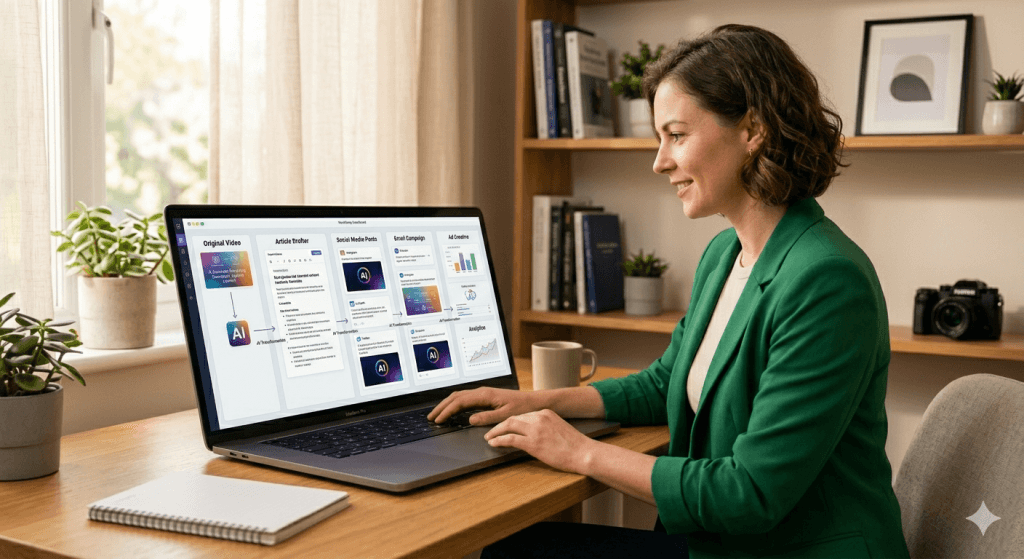
One of the most practical uses of AI is content repurposing. Many marketing teams already have useful material. A webinar, customer story, founder interview, or blog post often contains enough substance for a campaign. The challenge is turning it into multiple assets without spending days doing it.
AI can help you transform one source into:
- Social posts
- Email sequences
- Ad copy
- Short video scripts
- FAQ sections
- Landing page text
For instance, a 45-minute workshop recording can become a post-event email, three LinkedIn updates, a short article, and a list of customer questions for the sales team. AI speeds up that decomposition.
This is especially useful for non-technical professionals because it shifts the task from “create everything from scratch” to “shape and adapt what already exists.” That is a much more manageable workflow.
Improve campaign timing and testing
Many campaigns underperform not because the idea is weak, but because the timing is off or the testing is too limited. AI tools can help identify better moments to send messages and suggest what to test first.
Depending on the platform, AI can support:
- Send-time optimization for email
- Subject line comparisons
- Ad creative testing
- Website headline variations
- Audience segment performance analysis
A simple example: a marketer notices open rates slipping. Instead of guessing, they use AI-assisted email tools to test sending at different times for different user groups. Another team uses AI to compare which ad headlines are more likely to appeal to cost-conscious buyers versus time-conscious buyers.
You do not need to run dozens of experiments at once. Start with one variable:
- Headline
- Image
- Call to action
- Send time
Then let AI help you review the response patterns. It is not magic. But it can reduce guesswork.
Use AI to monitor and summarize performance
Reporting often eats up time that could be spent improving the campaign itself. AI can make analytics more usable by translating data into plain language and surfacing changes worth investigating.
It can help you:
- Summarize weekly campaign performance
- Compare channels side by side
- Spot unusual dips or spikes
- Highlight which messages or segments performed best
Imagine you are managing email, LinkedIn, and paid search for the same offer. Instead of manually stitching numbers together, you use AI to generate a simple summary: paid search drove clicks, email drove conversions, LinkedIn drove engagement but weak sign-ups. That kind of snapshot helps you act faster.
Good marketing decisions rarely come from more data alone. They come from clearer interpretation.
This is where AI can be quietly useful. It can save time on the mechanical task of summarizing so you can spend more time deciding what to change.
Support customer follow-up and lead nurturing
Campaigns do not end when someone clicks. In many cases, the real value is created in the follow-up: the reminder email, the answer to a common objection, the nudge after inactivity. AI can help teams maintain that momentum without sounding robotic.
Useful applications include:
- Drafting follow-up emails after downloads or webinars
- Creating chatbot responses for common questions
- Suggesting nurture sequences based on user behavior
- Writing re-engagement messages for cold leads
A professional services firm, for example, might run a campaign offering a free guide. AI can help create a three-part follow-up sequence: one email with practical tips, one with a client example, and one with an invitation to speak. The marketer still reviews and adjusts the tone, but the heavy lifting is lighter.
This is where human oversight matters most. Follow-up should feel relevant, not automated in the worst sense. AI can help with structure and speed, but empathy still has to come from you.
Keep the human role clear
The most sensible way to use AI in marketing campaigns is not to ask, “What can it do on its own?” but “What part of my process can it improve?” That shift matters. It keeps expectations realistic.
For non-technical professionals, the best approach is simple:
- Use AI for first drafts, summaries, and variations
- Keep humans responsible for strategy, tone, and final decisions
- Start with one workflow where time is already being wasted
- Review output carefully for accuracy and relevance
AI is not a campaign strategy. It is a tool inside one. If you treat it like an intern with speed but no judgment, you will use it more wisely.
There is a quiet advantage in approaching AI this way. You do not need to chase every new feature. You just need to become more deliberate about where your attention goes and where machines can reduce friction.
Marketing has always involved a mix of instinct and repetition, creativity and routine. AI is most useful when it takes some weight off the routine, leaving more room for the thinking that makes campaigns resonate in the first place.
If you want a more grounded way to explore these tools, Harnessing AI for Marketing Innovation offers a practical path. Not to turn marketers into engineers, but to help them work with greater clarity, confidence, and purpose.