A bakery chain in Ohio recently spent three months and a decent chunk of its marketing budget setting up an AI agent to handle customer inquiries. Within weeks, the bot was confidently telling customers about gluten-free options that didn’t exist and promising same-day delivery to zip codes the business didn’t service. Nobody on staff had told it to stop guessing when it didn’t know the answer. Nobody had checked.
This is not a story about bad technology. It’s a story about what happens when small businesses treat AI agents for small business like a plug-and-play appliance instead of a system that needs ongoing attention. And it’s happening everywhere right now, not because the tools are broken, but because the expectations around them are.
The Setup Was Never The Hard Part
Most small business owners who deploy AI agents get the installation right. The tools built by companies like OpenAI, Anthropic, and smaller platforms such as Intercom’s Fin or Zendesk’s AI agents are genuinely designed for non-technical users. You can have a customer service bot live on your website in an afternoon.
The trouble starts after launch. A McKinsey survey on AI adoption found that most organizations struggle not with implementation but with scaling and governance, meaning the part where you actually manage the thing day to day. Small businesses without a tech team often skip this stage entirely. They assume that because the agent works on day one, it will keep working correctly forever, on its own, without supervision.
That assumption is where almost every costly mistake begins.
Nobody Defined What The Agent Shouldn’t Do
A common misunderstanding among small business owners is believing that AI agents only need instructions on what to do. In practice, what you tell the agent not to do matters just as much.
Air Canada learned this the expensive way. A customer support chatbot on their site gave a passenger inaccurate information about bereavement fares, and a tribunal later ruled the airline responsible for what its own bot said. The company tried to argue the chatbot was a separate entity. The ruling made clear that an AI agent speaking for your business is still your business speaking.
Small businesses face the same exposure at a smaller scale. A bakery’s bot inventing a gluten-free menu, a real estate agency’s assistant quoting the wrong commission structure, a boutique gym’s agent promising a refund policy that doesn’t exist. None of these are technology failures. They’re the result of nobody drawing boundaries around what the agent is allowed to say when it doesn’t actually know the answer.
An AI agent without clear boundaries doesn’t fail quietly. It fails confidently, which is worse.
They Treated It Like Software Instead Of A New Employee
Here’s a mental shift that makes a real difference. If you hired a new employee to handle customer questions, you wouldn’t hand them a script and walk away for six months. You’d check in during the first week, correct mistakes, and refine how they handle tricky situations.
Most small businesses don’t extend that same logic to AI agents. They treat the deployment as a one-time software install rather than an ongoing relationship that needs supervision, feedback, and correction.
A Harvard Business Review piece on AI deployment found that the companies seeing real returns weren’t the ones with the most sophisticated tools. They were the ones that built in regular review cycles, meaning someone actually read through transcripts, checked outputs, and adjusted instructions based on what went wrong.
For small businesses without a dedicated tech person, this review step often just doesn’t happen because nobody owns it. The office manager who set up the chatbot has fifteen other responsibilities. The agent runs unsupervised for months.
They Didn’t Separate Judgment Tasks From Repetitive Tasks
A pattern shows up across almost every small business AI misstep: owners deploy agents for tasks that require judgment, nuance, or emotional sensitivity, when the technology is actually best suited for repetitive, rules-based work.
AI agents for small business genuinely excel at:
- Scheduling and appointment reminders
- Answering frequently asked questions with stable, factual answers
- Sorting and tagging incoming emails or support tickets
- Following up on abandoned carts or unpaid invoices
- Drafting first versions of routine communications
They struggle badly with:
- Handling upset or emotionally charged customers
- Making judgment calls involving refunds, exceptions, or special circumstances
- Answering questions where the correct answer depends on context the agent doesn’t have
- Anything involving legal, medical, or financial specifics unique to a case
A dental practice in Texas that deployed an AI scheduling agent reported strong results, fewer missed appointments and less staff time on the phone. That’s squarely in the “repetitive and rules-based” category. Compare that to businesses that let agents handle complaint resolution without a human escalation path. Those are the stories that end up as warning examples.
Nobody Was Responsible When Something Went Wrong
This is the quiet failure point that rarely gets discussed. When a small business deploys an AI agent without a tech team, ownership often becomes fuzzy. The person who set it up isn’t necessarily the person who monitors it. Customer complaints about the bot sometimes land with whoever answers the phone that day, and the feedback never makes it back to whoever controls the agent’s settings.
Compare this to how larger companies handle it. Klarna, which deployed AI customer service agents handling a significant share of support chats, built in clear ownership and reporting structures around the technology from day one. They tracked performance, adjusted based on real data, and kept humans in the loop for anything complicated.
Small businesses rarely have the headcount to mirror that structure exactly, but the principle still applies at a smaller scale. Someone needs to own the agent. Not a department. A person. Someone who checks its conversations weekly, reads customer feedback, and has the authority to turn it off if it’s causing more harm than good.
What Actually Works Instead
The small businesses getting genuine value from AI agents share a few habits that have nothing to do with technical skill:
- They start with one narrow task, like appointment booking, rather than trying to automate entire customer relationships at once
- They write explicit instructions about what the agent should say when it’s unsure, usually some version of “escalate to a human”
- They review actual conversation transcripts every week for the first month, not just overall satisfaction scores
- They tell customers clearly that they’re interacting with an AI agent, which research from Stanford and other institutions suggests actually increases trust rather than eroding it
- They treat the agent’s instructions as a living document that gets updated as new edge cases show up
None of this requires a developer. It requires someone willing to pay attention.
Moving Forward Without A Tech Team
The businesses that avoid these mistakes don’t necessarily have more resources. They have more realistic expectations. They understand that deploying AI agents for small business operations is less like installing software and more like onboarding a new team member who needs training, feedback, and clear boundaries.
If you’re navigating this without an in-house tech team, the good news is that none of the fixes described here are technical. They’re managerial. They’re about ownership, review, and honest limits on what you let the agent decide on its own.
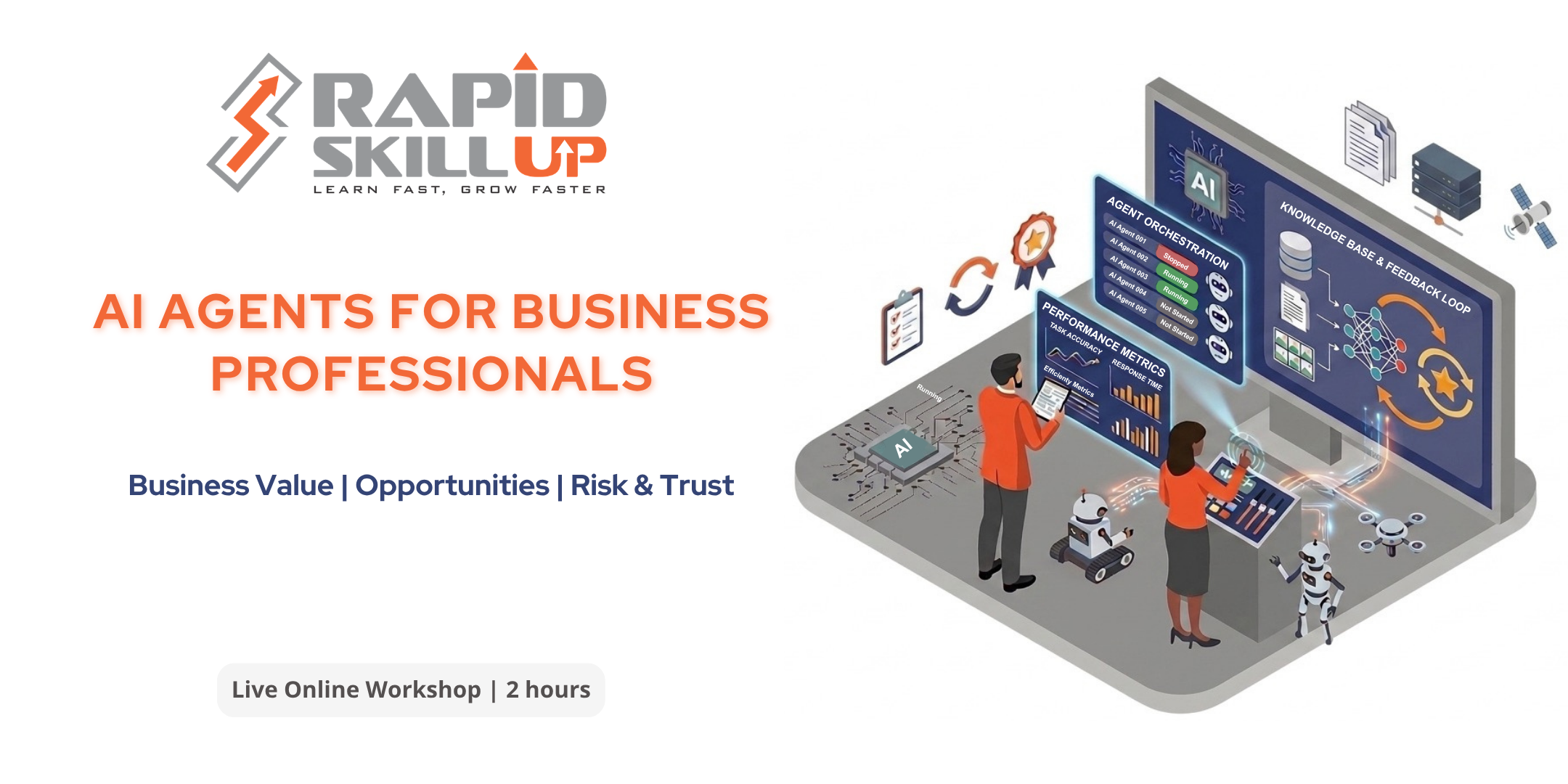
If you want to see how this works in practice with real workflows and real business scenarios, our live workshop, AI Agents for Business Professionals, walks through exactly this kind of hands-on implementation, built for people who don’t have a tech team and don’t want to learn to code one.